Business Energy Charges Explained
Understand commercial electricity and gas charges, standing charges, and third-party costs. Clear explanations to help UK businesses control energy bills.
What Makes Up Your Energy Bill?
Your business energy bill is made up of many different costs. Some are for the actual energy you use (wholesale), while others are fixed daily charges and third-party costs that support the UK’s energy system and Net Zero goals.
These third-party costs (especially network charges and government levies) are the main reason standing charges have increased sharply and will continue to rise through the 2020s.
Typical UK Business Electricity Bill Breakdown (2025)
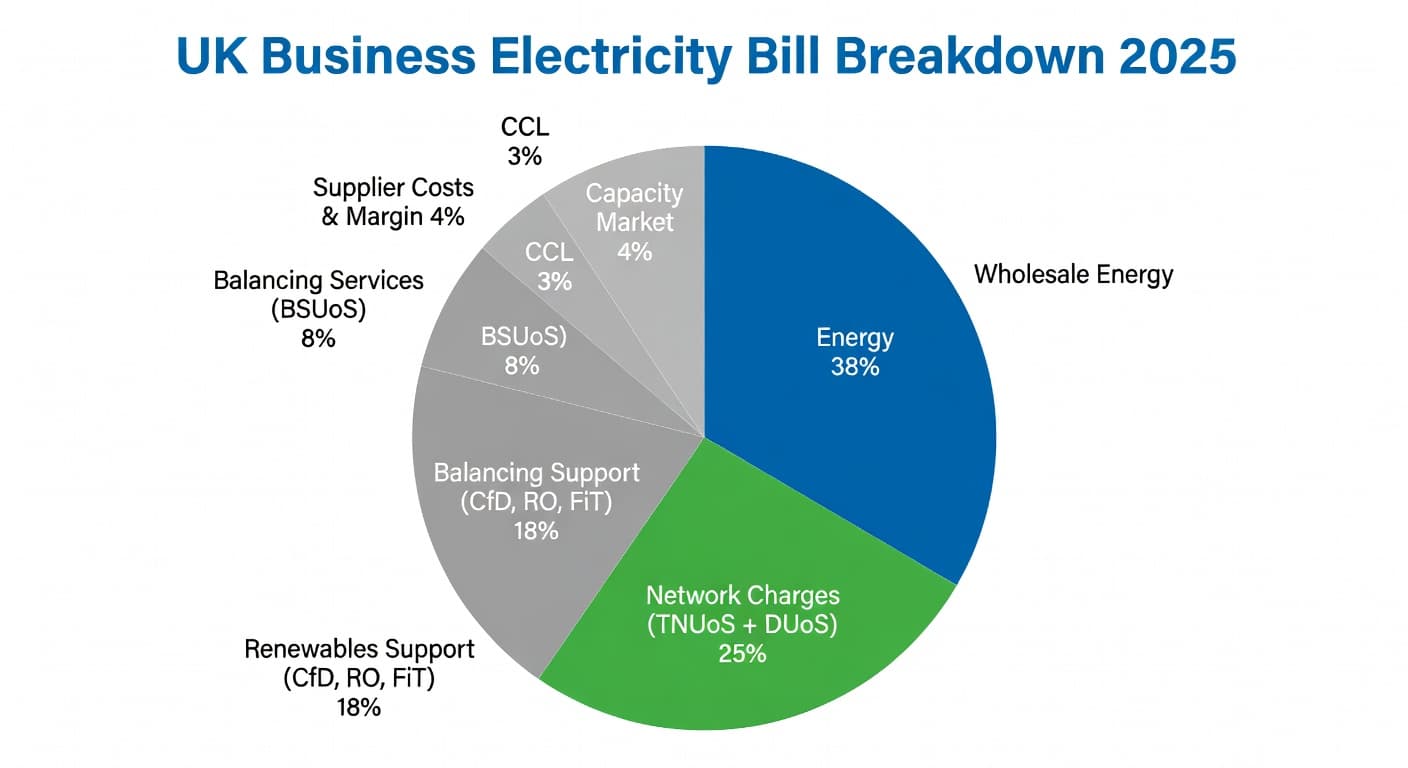
Source: Aggregated from Ofgem, National Grid ESO and DESNZ data 2025
The Main Third-Party Costs Driving Increases
CfD (Contracts for Difference)
Payments to renewable generators (especially offshore wind) when the market price is below the strike price. As more renewable capacity comes online, total CfD payments are rising significantly.
RO (Renewables Obligation)
Legacy support scheme for older renewable projects. Still adds several £/MWh to bills and will only slowly decline.
RAB Levy (Regulated Asset Base)
New funding model for large infrastructure like Sizewell C nuclear. Costs are socialised across all bill payers and will increase sharply in the late 2020s.
TNUoS & BSUoS (Network & Balancing)
Costs of upgrading and operating the transmission and distribution networks plus real-time balancing. Both are rising fast due to the massive grid investment needed for Net Zero and more intermittent renewables.
CCL (Climate Change Levy)
Tax on business energy use designed to encourage efficiency and low-carbon generation. Rates have been increasing.
Other Policy Costs
Includes Capacity Market payments, Feed-in Tariff (FiT) legacy costs, and various green levies. All are ultimately funded through customer bills.
Why These Costs Will Keep Rising to 2030
The UK’s legally binding Net Zero target by 2050 requires a massive transformation of the electricity system. This transition is expensive and the costs are largely passed through to consumers via standing charges and levies:
- Grid reinforcement: Hundreds of billions of pounds needed to connect new offshore wind, solar, batteries and data centres. TNUoS charges will rise significantly.
- More renewables = higher CfD costs: As more projects reach Final Investment Decision, the volume of CfD payments will grow before wholesale prices fully reflect the low marginal cost of renewables.
- New nuclear via RAB: Sizewell C and future projects are being funded through a Regulated Asset Base model — a new standing charge-style levy that will grow through the 2030s.
- Balancing a variable system: More wind and solar means higher BSUoS costs for flexibility and back-up.
- Decarbonising industry and transport: Electrification and hydrogen will require even more network capacity.
These are not short-term spikes — they are structural costs of delivering Net Zero.
Projected UK Business Electricity Bill Breakdown in 2028
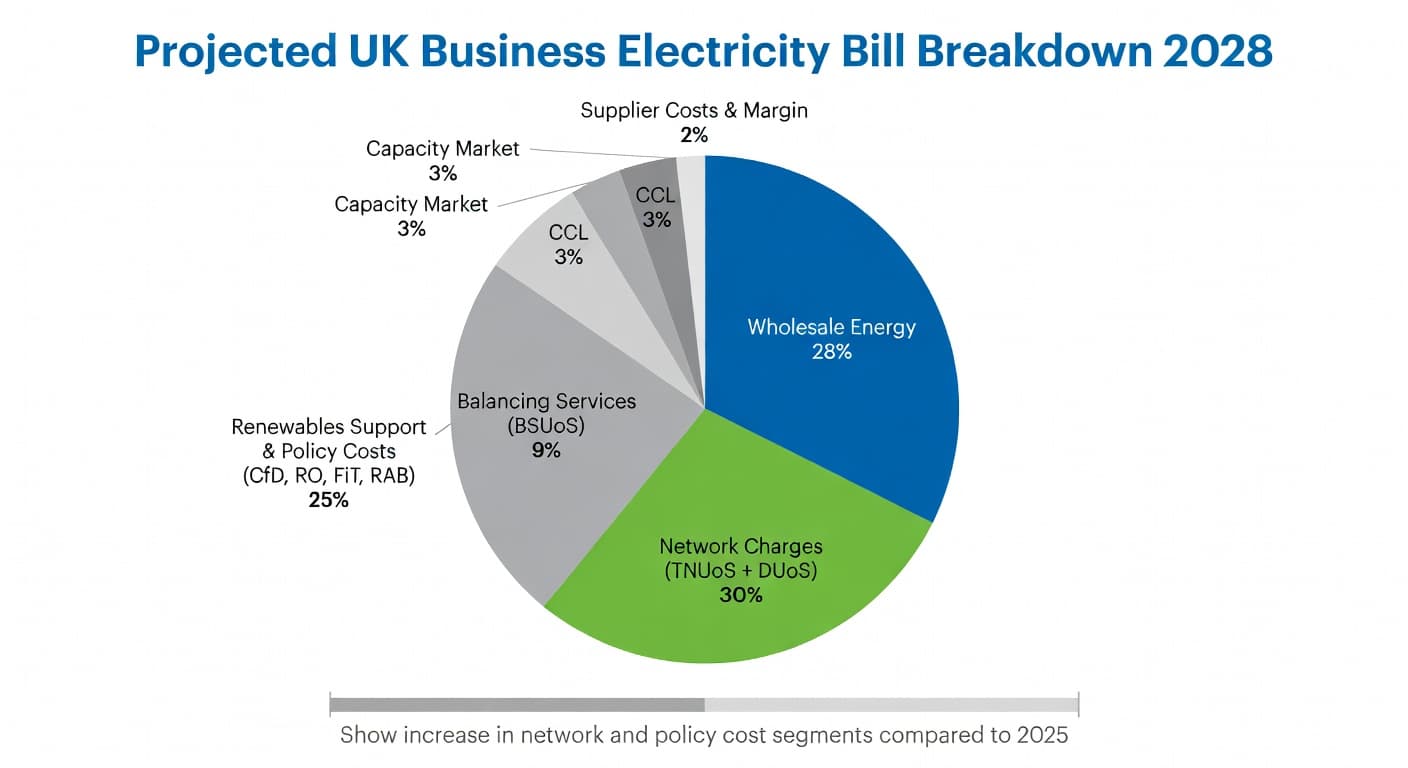
Projected 2028 breakdown (illustrative). Network and policy costs are expected to grow as a percentage of the bill due to the scale of investment required for Net Zero.
Projected Rise in Key Policy & Network Costs
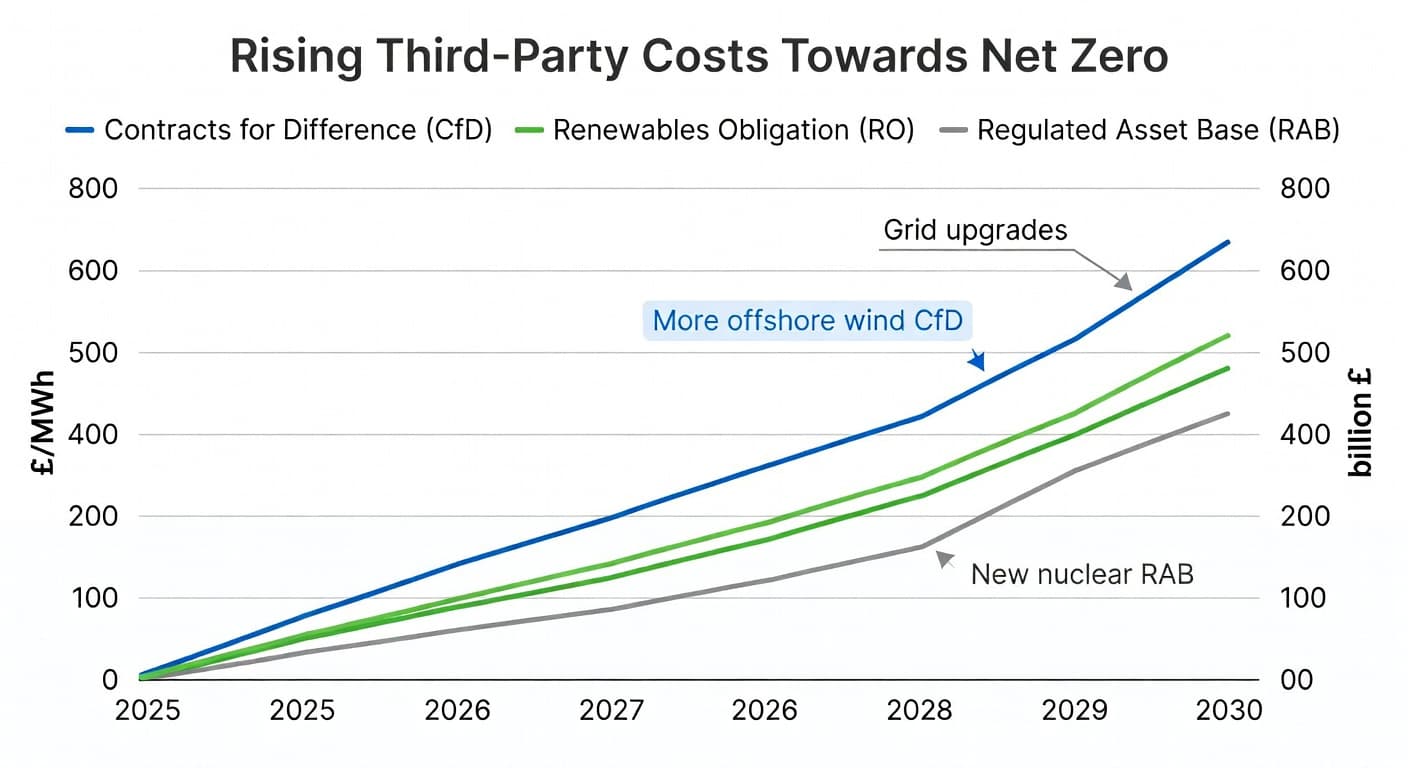
Illustrative projection based on Ofgem, National Grid ESO and DESNZ scenarios
What Your Business Can Do
- • Review your current tariff and connection capacity (kVA) — many businesses are overpaying
- • Shift flexible load to cheaper periods (demand flexibility)
- • Consider behind-the-meter generation or storage
- • Explore corporate PPAs or sleeved renewable contracts
- • Prepare for MHHS — half-hourly data will become essential
- • Get an independent review of your total energy costs and contract strategy
Want a clear breakdown of your own bill and options to reduce third-party costs?
Get a free energy cost review