Business Electricity Standing Charges Explained
What actually drives the fixed daily charge on your business electricity bill — and why it varies so much between sites.
What Is a Standing Charge?
A standing charge is the fixed daily (or monthly) fee you pay on your business energy bill regardless of how much electricity or gas you actually use. It covers the cost of having a live connection to the network, the meter itself, data services, and your supplier’s fixed operating costs.
Unlike the unit rate (p/kWh), standing charges are mostly made up of third-party pass-through costs and regulatory charges that suppliers must recover. They are not primarily driven by wholesale energy prices or the big renewable policy levies (CfD, RO, RAB) that dominate unit rates.
What Actually Drives Your Standing Charge?
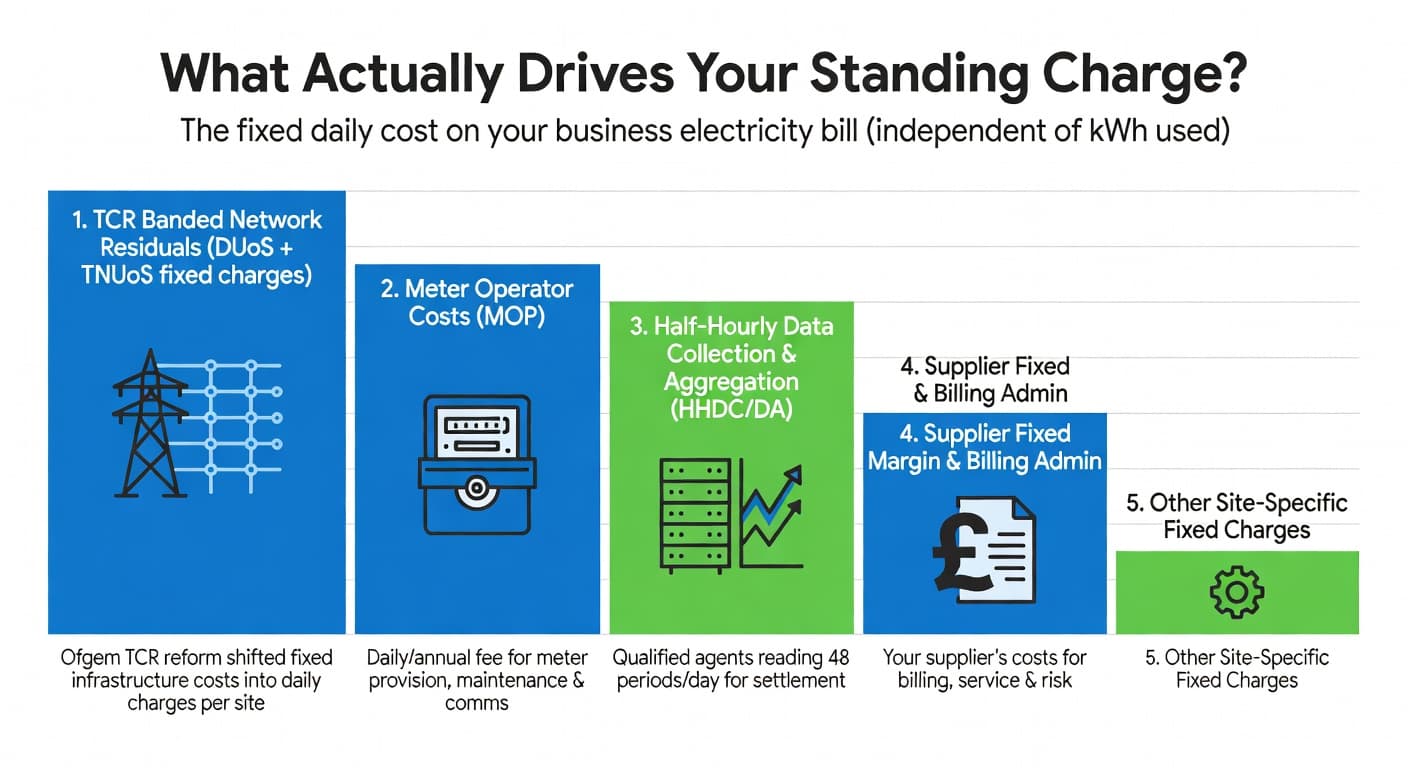
The main components that make up the fixed daily standing charge on a typical UK business electricity bill
The Targeted Charging Review (TCR) — The Biggest Driver
Ofgem’s 2019 Targeted Charging Review fundamentally changed how network costs are recovered.
Before TCR, a large part of the fixed costs of the electricity network (pylons, cables, substations) was recovered through variable per-kWh charges or triad-based demand charges. Larger users could reduce or avoid these costs through on-site generation, load shifting, or high load factors.
TCR moved the “residual” (non-cost-reflective) element of both TNUoS and DUoS charges to fixed daily/annual charges per final-demand site. This prevents cost avoidance and ensures every site contributes to the fixed infrastructure that must be maintained regardless of usage.
Result: Standing charges rose sharply for many businesses from April 2021 (transmission residuals) and April 2022 (distribution residuals).